85 BC – AD 110
Ad-Deir is one of the greatest Nabataean monuments in Petra and among the largest rock-cut facades carved into the rose-colored mountains. It stands approximately 47 meters high and is distinguished by its massive scale and architectural simplicity compared to more elaborately decorated façades. The monument was carved into a towering mountain face on the western side of the city and is accessed by ascending hundreds of rock-cut steps, making the journey a unique experience that combines physical effort with the awe of discovery.
The significance of Ad-Deir lies in its religious and ritual role during the late Nabataean period. Although commonly known as “the Monastery,” this name dates to the Byzantine period, when the structure was later used as a Christian monastery, rather than to its original Nabataean function.
It is believed that the façade served as a venue for religious rituals and gatherings associated with Nabataean worship, and it may have been linked to the veneration of a king or a local deity. A Nabataean inscription discovered near the monument refers to King Obodas I, supporting the possibility that the site was connected to the commemoration of a ruler of the Nabataean Kingdom.
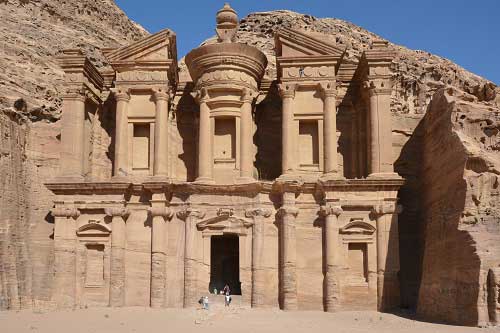
The façade of Ad-Deir consists of two main levels, emphasizing monumental scale and architectural form rather than dense decoration. Several simple niches are distributed across the façade and were likely intended to hold statues or religious symbols. The main entrance leads to a spacious interior hall with a plain design, devoid of carved decoration except for two long benches along the sides, which may have been used for seating or for placing offerings during religious rituals.
Evidence suggests that the area in front of the façade was once enclosed as a large courtyard used for large gatherings during major religious festivals or ceremonies. Over time, and with the transformation of the region during the Byzantine period, Ad-Deir was used as a Christian place of worship, explaining the presence of symbols and markings dating to that era.
While access to Ad-Deir today is via a tourist path that follows a long series of rock-cut steps, this route also played an important role in antiquity, as it likely contributed to isolating the site and making it suitable for closed religious gatherings and rituals requiring seclusion and tranquility.
By the second century AD, during the reign of the Nabataean king Rabbel II, further development appears to have taken place at the site, indicating that Ad-Deir retained its importance into the later phases of Nabataean rule. Nevertheless, its Christian use in subsequent periods is what ultimately gave the monument its present name, which has endured to this day.
Today, Ad-Deir is a major destination for visitors to Petra, who come to experience the dramatic combination of breathtaking mountain scenery and remarkable Nabataean architecture. The monument stands as a testament to the Nabataeans’ mastery of rock carving and their ability to create monumental structures that transcend time, remaining one of the most significant archaeological witnesses to the history and civilization of Petra.